

The first four parts of this series made the case that agentic commerce won’t dismantle the governance and compliance infrastructure that enterprise procurement depends on, and that agents will make that infrastructure more critical, not less. When a human buyer makes a mistake in a PunchOut session, someone catches it. When an agent does, no one is watching. The compliance controls, business rules, and deterministic data handling that good integration middleware provides don’t become optional in an agentic world. They become the only thing standing between a capable AI and an enterprise procurement disaster.
Part 4 identified where that opportunity is largest. This part is about what the infrastructure to capture it actually looks like.
The Honest Starting Point
Before introducing what we’re building, it’s worth acknowledging something we said plainly in Part 2: the demand signals for agentic procurement are weak. Suppliers are reluctant. Buyers aren’t actively asking their trading partners to support it. The “autonomous procurement” narrative running through analyst reports and vendor keynotes is, for now, ahead of the market.
We believe that’s true. And we’re building for it anyway, carefully and with eyes open.
Here’s the logic. If agentic commerce fails to gain meaningful traction, the cost of having built an early framework for it is low. But if it does take hold, and the technology trajectory, the pace of AI adoption inside procurement platforms, and the long-term pressure on digital laggards all suggest it will, then the question of how agents participate in B2B transactions becomes the defining infrastructure question of the coming years.
Our thesis is this: if agentic commerce is viable, the middleware layer becomes more important, not less. The security, governance, compliance, and determinism that enterprise procurement requires don’t go away because an AI agent is doing the shopping. They become harder to guarantee. That’s exactly the problem TradeCentric is positioned to solve.
What UPOP Is
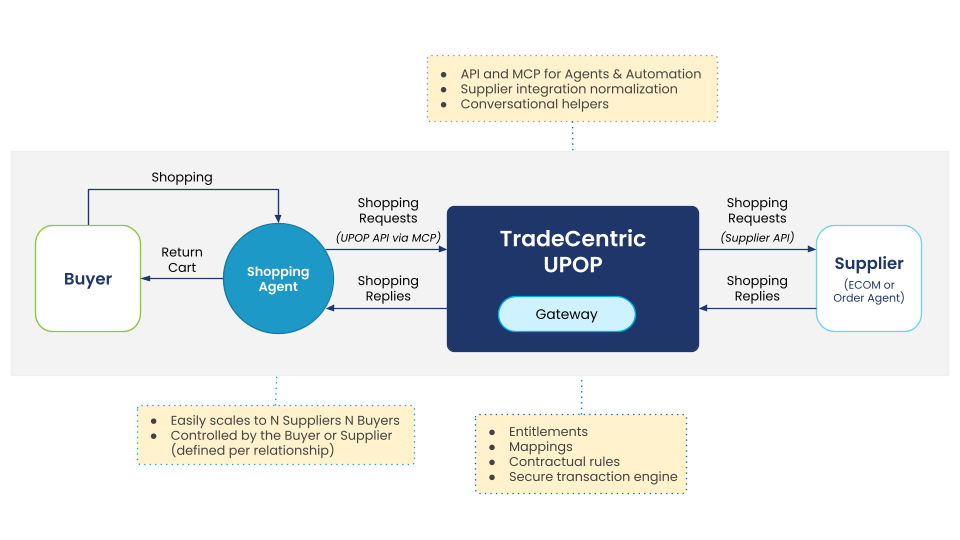
The Universal PunchOut Platform (UPOP) is a unified API and Model Context Protocol (MCP) layer built on top of the TradeCentric Gateway. It provides an integration access layer to supplier catalogs, cart management, and conversational shopping helpers, extending TradeCentric’s existing infrastructure (authentication, compliant business and transformation rules, and cart transfer) to support AI-driven purchasing workflows.
In practical terms, UPOP does three things:
It enables the translation of natural language intent into structured API execution. When a buyer’s agent expresses an intent, for example “find me 5000 heavy-duty nitrile gloves, medium sized,” UPOP’s MCP enables the agent to interpret that request and map it to the correct authenticated API calls, in this case a product search, against the supplier’s platform. The agent doesn’t need to know the supplier’s API schema. It only needs to know how to call UPOP which then handles the execution. This is agentic commerce in its more autonomous form: the agent acts, UPOP governs. The buyer’s intent becomes a compliant procurement action without a human navigating a supplier website and without sacrificing the controls that enterprise procurement requires.
It preserves the governance layer that enterprise procurement requires. Authentication, entitlements, contract pricing, business rule enforcement, and cart transfer all run through the same TradeCentric Gateway infrastructure that governs traditional PunchOut today. The conversational interface is new. The compliance controls underneath it are not.It collapses the n-to-n integration problem. Without UPOP, every buyer’s agent would need to learn how to interact with every supplier’s system, and every supplier would need to support every agent’s protocol. UPOP collapses that complexity into a single interoperability layer, the same architectural role TradeCentric has always played, extended into the agentic context.
Addressing the Supplier Control Question
Part 3 established that suppliers won’t expose their catalogs to uncontrolled agents, and that the supplier-controlled conversational model is the most commercially viable path precisely because it keeps product data, pricing, and CX under the supplier’s control. That tension doesn’t disappear with UPOP. It’s one of the core questions we’re working to resolve.
The supplier concerns are legitimate and well-founded: loss of control over the customer experience, exposure of pricing to real-time comparison, and the risk that product data pulled through an agent interaction gets retained or reused beyond the immediate transaction. Addressing each of these concerns is a core goal for UPOP’s governance layer, one we’re actively working to define.
Two of the most promising directions, shaped by what we’ve already heard from suppliers:
Governance controls built into the platform. Controls such as rate limits on the volume of product data an agent can retrieve in a session, or strict data handling rules that prevent storage of product data beyond the immediate cart-to-PO workflow, could address the data exposure and comparison-shopping concerns without requiring suppliers to change anything on their end. These are two examples of the kinds of mechanisms we intend to explore and validate with design partners.
Supplier-controlled conversational agents on top of UPOP. For suppliers who want full control over the customer experience, UPOP supports a model where the conversational agent itself is controlled and operated by the supplier. The supplier builds and controls the conversational interface, enforcing their own brand experience through tone, personalization, and product guidance, while UPOP handles the governed integration underneath. This gives suppliers the same control they have today over their PunchOut experience, extended into the conversational model. It also gives them a stronger contractual basis for restricting how their product data is used, since the interaction runs through their own agent rather than the buyer’s.
These aren’t finished answers. They’re directions shaped by what we’ve already heard from suppliers, and the ones we believe are most worth testing rigorously through the Design Partner engagement.
Why This Matters for the Market
Part 4 identified the most compelling opportunity for agentic PunchOut: the estimated 65% of manufacturers who haven’t meaningfully invested in digital channels. For that segment, UPOP lowers the barrier to enterprise B2B commerce significantly. A full e-commerce site is no longer a prerequisite. A buyer-specific catalog, combined with the UPOP integration layer and governed cart transfer, is enough to get started.
For buyers, it’s a path to bringing reluctant suppliers onto governed digital purchasing rails without requiring them to overhaul their systems first. For suppliers, it’s an on-ramp to enterprise commerce that’s more accessible than anything that’s come before, and one that keeps their data and CX controls intact.
What We’re Looking For in Design Partners
We’re not ready to call UPOP a product. We’re ready to call it a thesis worth testing, rigorously, in the real world, with partners who have the most to gain from getting this right.
We’re looking for buyers and suppliers in our ecosystem who are willing to exercise the concept in their own environments, against their own trading relationships. Not audiences for a polished demo, but organizations willing to stress-test the assumptions: What works? What breaks? Where do suppliers draw the line on data access and CX control? What governance mechanisms are actually sufficient, and which ones are just reassuring on paper?
That feedback will directly shape what UPOP becomes. The organizations that engage early will have more influence over its direction than any roadmap document we could write today.
What We’re Not Claiming
UPOP is a framework and a prototype built on a well-founded thesis. We believe that if agentic commerce takes hold in enterprise procurement, the middleware layer will be essential infrastructure, and that TradeCentric is uniquely positioned to own that layer. But we also know that “if” is doing real work in that sentence.
The supplier control questions are real. The demand signals are still weak. The governance mechanisms that will make agentic PunchOut trustworthy for both sides are still being defined. We’re not pretending otherwise.
What we are confident in is this: if the infrastructure for agentic PunchOut is going to be built well, it will be built by someone who understands the full stack, the procurement workflows, the integration requirements, the supplier relationships, and the compliance obligations. That’s the foundation we’re building on.
PunchOut isn’t going away. It’s growing up. And UPOP is how we’re helping it get there.
Get the Agentic Commerce Readiness Framework for B2B Suppliers
Download the 7-part framework to assess your own agentic commerce readiness