B2B Integration Platform for eCommerce and eProcurement
TradeCentric is a managed integration platform that connects your existing eCommerce and eProcurement systems. Your platforms stay in place. We build, monitor, and maintain the connections between them, which reduces the custom integration work your team carries.















Trusted Worldwide—From the Fortune 500 to Global Enterprises
What a managed integration platform does
A managed integration platform sits between supplier eCommerce systems and buyer eProcurement systems. It translates documents between the two, so a purchase order created in any eProcurement system arrives in the supplier’s system in a format that system can process.
The difference between managed integration and an iPaaS is ownership. An iPaaS gives your team the tools to build and maintain each connection. A managed integration platform builds and maintains them for you, including the updates that follow when a buyer changes its requirements.
TradeCentric operates as the integration infrastructure layer in a three-part model:
- Supplier eCommerce. Your existing storefront, catalog, and pricing logic stay in place.
- TradeCentric. Mapping, validation, monitoring, and document exchange across formats and protocols.
- Buyer eProcurement and ERP. Their purchasing workflows, approval rules, and systems of record stay unchanged.
Documents move in both directions across this layer: PunchOut sessions, purchase orders, acknowledgements, shipping notices, and invoices.
Connect to the systems you already use
Your buyers run their purchasing processes through procurement systems. TradeCentric maintains connections to 220+ eProcurement and ERP systems and 75+ eCommerce platforms, so onboarding a new buyer becomes a configuration step rather than a new integration project.
- A trading partner network of 5,000+
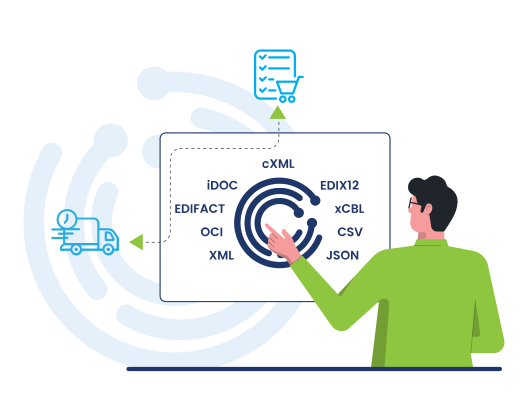
- Support for cXML, OCI, EDI, JSON, and custom formats





Eliminate document communication barriers between systems
Two buyers on the same eProcurement platform can require different document formats, field mappings, and validation rules. TradeCentric’s Data Transformation handles that variability seamlessly, so your team does not build a new integration each time a buyer’s requirements differ from the last one.
- Field-level mapping and validation against buyer requirements
- cXML, OCI, EDI, JSON, and custom formats
- Data enrichment for fields the source system does not supply
If one-off connections have become the constraint on how fast you can onboard buyers, see how TradeCentric helps simplify your integration architecture.
See how Data Transformation worksSee how your buyer connections are actually performing
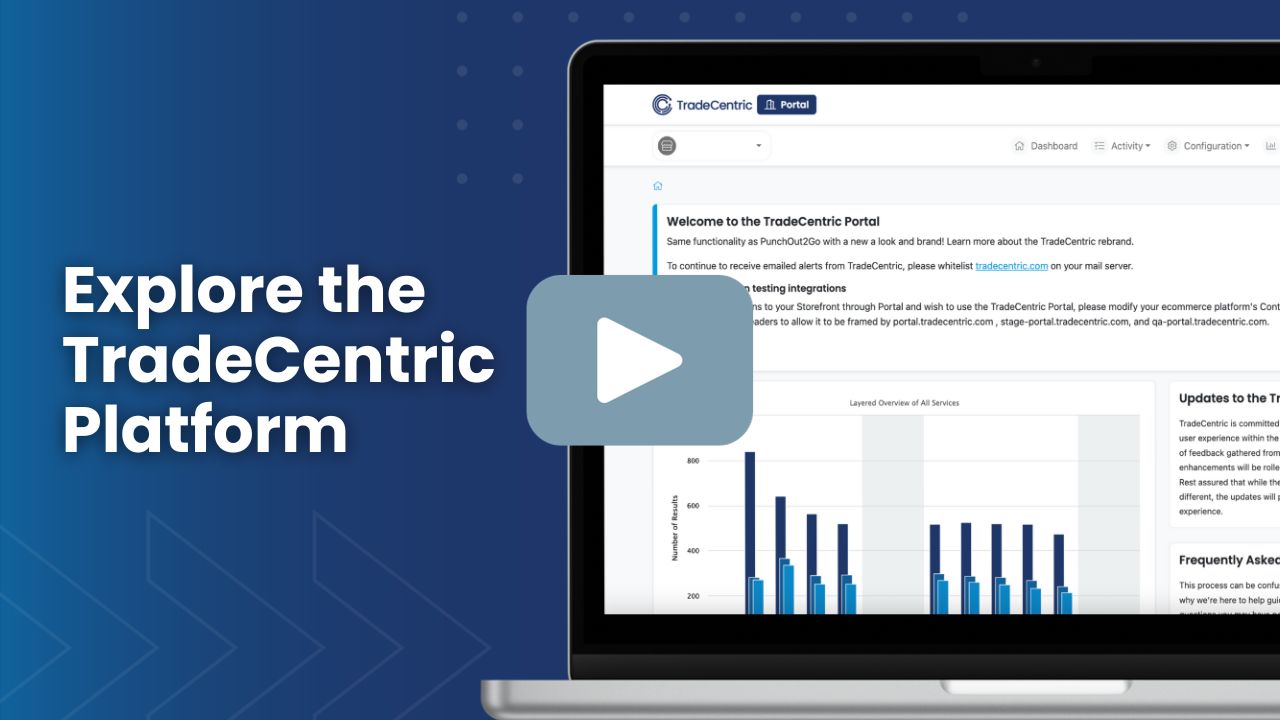
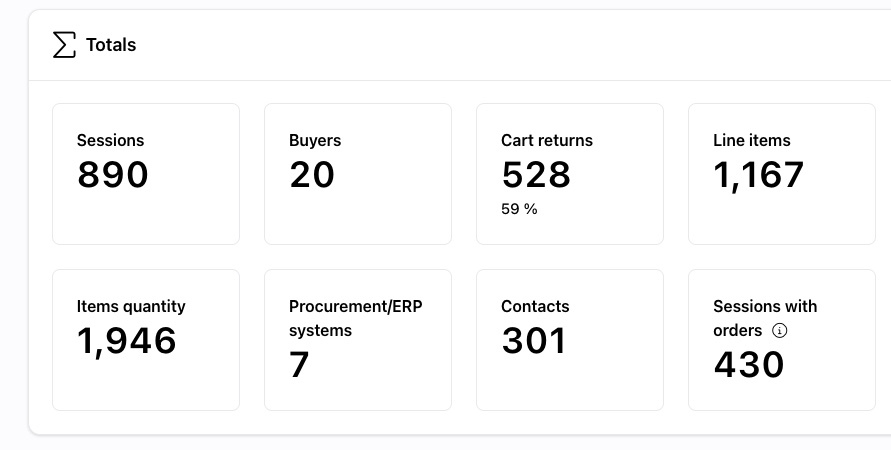
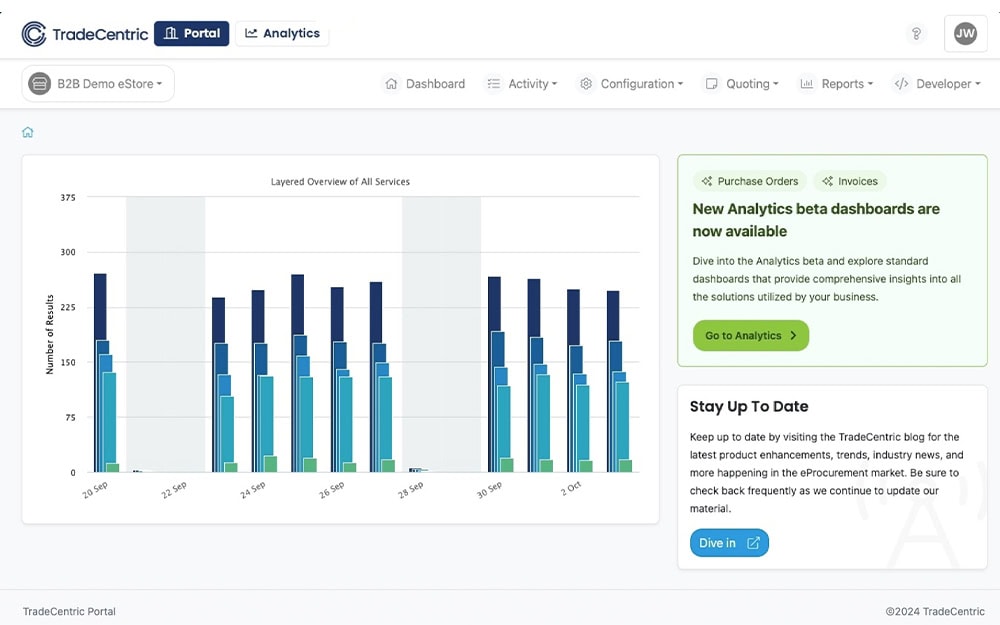
Most integrations lack visibility into how well it is running. TradeCentric Analytics surfaces transaction volumes, failure rates, and trading partner performance without your team building dashboards for it.
- Trading partner performance, connection by connection
- Transaction trends by solution and document type
- Integration health monitoring with failure alerting
- Risk and opportunity flags across your partner network
Resolve connection issues without opening a ticket
The TradeCentric Business Intelligence Portal gives your team transaction-level detail, connection testing, and self-service troubleshooting. Most customers can answer their day-to-day questions without a support request.
- Real-time transaction and spend data
- Connection testing before a buyer goes live
- Self-service troubleshooting with error-level detail
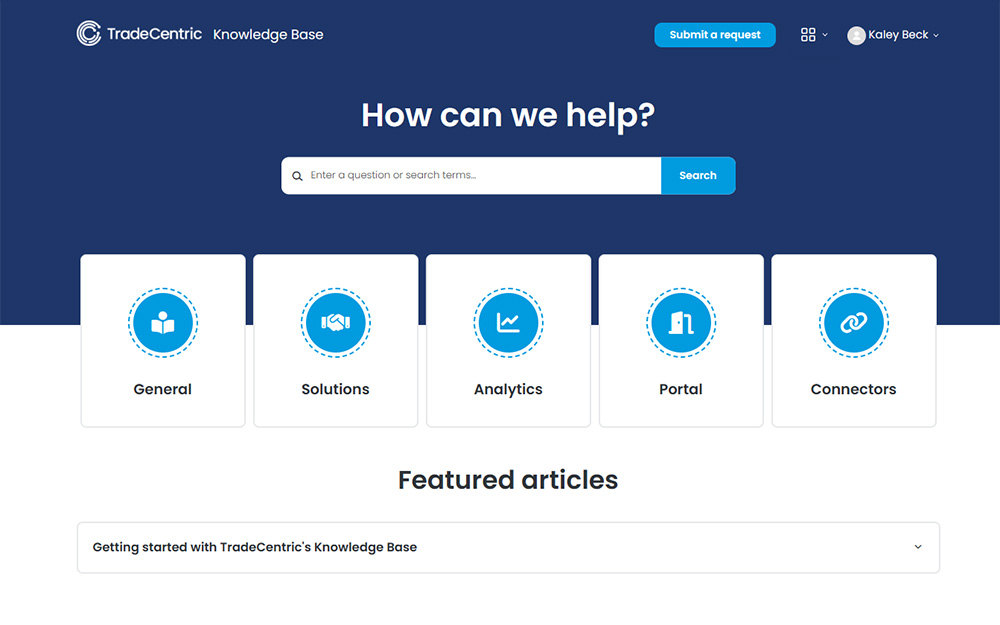
Discover, Learn and Solve with Knowledge Base
Exclusive to TradeCentric customers, our Knowledge Base makes finding answers easy with a user-friendly self-service experience designed to streamline your support journey.
- Quickly locate the information you need via search tools
- Navigate resources tailored to your solutions
- Access related articles and ratings for enhanced guidance





Security and compliance certifications
Your buyers will ask about security before they connect, and enterprise procurement teams increasingly make certification a condition of onboarding. TradeCentric maintains ISO 27001 and SOC 2 Type 2 certification, and the platform is built to meet the data handling requirements your buyers are accountable for.
- ISO 27001 and SOC 2 Type 2 certified
- Peppol network support for cross-border purchase orders and invoicing
- GDPR compliant
- Encryption for PCI data in purchase order transmission
eProcurement Solution Suite
What the platform runs
Built to scale the complete transaction cycle, not just connect once
PunchOut Catalog
Buyers shop your catalog from inside their procurement system and return a cart that becomes a requisition.
Explore the PunchOut solution
Purchase Order Automation
Purchase orders arrive in your system in a format it can process, without rekeying.
Explore PO Automation
Invoice Automation
Invoices reach the buyer’s AP system in the format their platform requires, which shortens payment cycles.
Explore Invoice Automation
PO Acknowledgement
Confirm receipt, pricing, and availability back to the buyer automatically.
Explore PO Acknowledgement
Advanced Shipping Notice
Send shipment details ahead of delivery so receiving matches against it.
Explore Advanced Shipping Notice
Most suppliers start with two or three of these and add others as buyer requirements expand. The TradeCentric Connect packages show how they are typically bundled.
TradeCentric platform FAQs
Yes. TradeCentric connects your eCommerce system to your buyers’ eProcurement systems. It does not replace your storefront, your catalog, or your pricing logic. If you do not have an eCommerce platform in place, that comes first.
An iPaaS gives your team tooling to build and maintain integrations. A managed integration platform builds and maintains them for you, including updates when a buyer changes its requirements. The difference is who carries the ongoing operational work.
The platform supports 220+ eProcurement and ERP systems, including Coupa, SAP Ariba, JAGGAER, Oracle, and Ivalua, and 75+ eCommerce platforms. You can see the full list on the integrations page.
cXML, OCI, EDI, JSON, and custom formats. Field mapping and validation are configured per buyer, so two buyers on the same platform can have different requirements without a new build.
No. The platform sits between existing systems and moves documents between them. Your ERP, eProcurement platform, and eCommerce system all stay in place.
Timelines depend on the systems involved and the buyer’s requirements. Pre-built connectors and managed configuration shorten the cycle compared with a custom build, and your integration team can give you a timeline for a specific buyer connection.