
Raleigh, NC, May 4, 2026 — TradeCentric, the leading provider of B2B eProcurement integrations, today announced UPOP, a governed integration platform in active development, designed to help buyers, suppliers, and AI agents connect safely and reliably as B2B commerce enters the age of agentic buying.
The Universal PunchOut Platform is being developed as a governed integration layer for next-generation B2B commerce. As AI agents begin to influence and participate in enterprise purchasing workflows, organizations will need infrastructure that can support autonomy without compromising control, compliance, auditability, or the unique buyer-supplier relationships that define B2B commerce.
Why agentic commerce needs B2B infrastructure
Agentic commerce will not replace today’s commerce and procurement systems. It will depend on them.
Enterprise buying still requires systems of record to enforce contract pricing, identity, entitlements, policy, approvals, financial controls, invoice matching, and audit trails. The opportunity is not to bypass those systems, but to create intelligent, secure handoffs between those systems and the AI agents that will increasingly support B2B buying decisions.
Unlike consumer commerce, B2B buying is not one-size-fits-all.
Every trading relationship can involve:
- Unique catalogs and product availability
- Contract-specific pricing and terms
- Buyer-specific entitlements and permissions
- Compliance and approval requirements
- Financial controls and audit trails
- Integration requirements across procurement, ERP and commerce systems
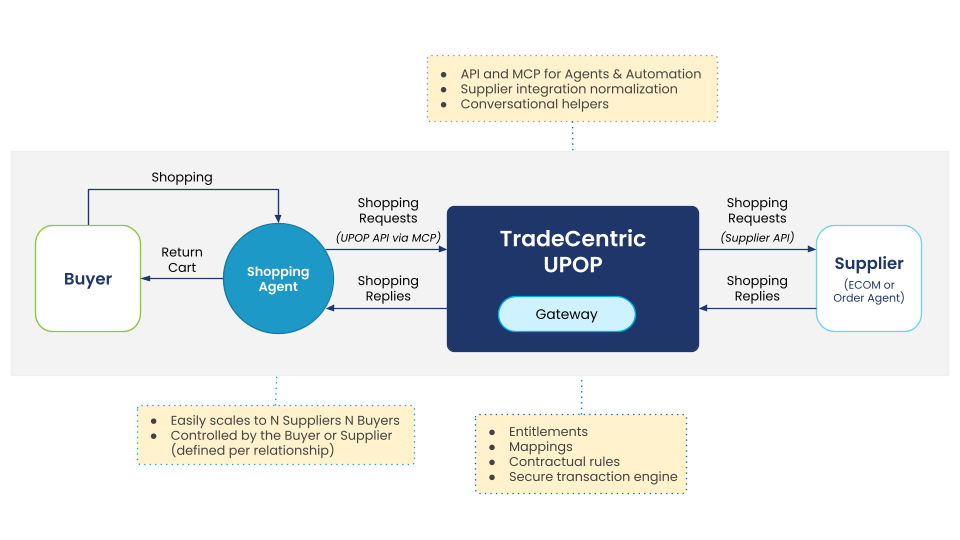
UPOP is being designed to help preserve those governed relationships while creating a path for agentic commerce to work across complex enterprise environments.
For technology and integration partners, UPOP creates an opportunity to help define how AI-enabled buying experiences connect into the governed systems, workflows and trading relationships that already power B2B commerce.
“AI agents may change how B2B buying happens, but they will not eliminate the complexity behind it,” said Steve Frechette, Chief Product and Technology Officer at TradeCentric. “Enterprise commerce still depends on trusted relationships, governed systems, and reliable integrations. UPOP is being developed to make that infrastructure agent-ready.”
Future-proofing today’s integration investments
For suppliers, UPOP is intended to provide a practical path through uncertainty. Organizations investing in commerce and procurement integrations today need confidence that those investments will continue to support future buying models.
TradeCentric is developing UPOP to help customers build the infrastructure they need now while preparing for agent-enabled buying over the next three to five years.
UPOP is being designed to support:
- Secure connections between AI agents, buyers, suppliers, and enterprise systems
- Governed workflows that preserve buyer-specific rules and requirements
- Agent-ready infrastructure that builds on existing commerce and procurement investments
- Reliable handoffs between AI-driven experiences and systems of record
- A future path from today’s integrated buying experiences to tomorrow’s agentic workflows
Design Partner Program
TradeCentric is now inviting a select group of customers, technology partners and integration partners to participate in the UPOP Design Partner Program. Participants will receive early access to the platform and work directly with TradeCentric product and engineering teams to provide feedback as the platform moves toward production.
Interested organizations can apply here.
See TradeCentric at B2B Online
TradeCentric will discuss UPOP and the future of agentic commerce at B2B Online, taking place May 4-6, 2026.
Attendees can visit TradeCentric at Booth 304 or join Workshop #6: “Agentic Commerce & eProcurement: Asking the Hard Questions” on Monday, May 4 from 1:40 PM to 2:30 PM.
The session will explore agentic commerce in the context of B2B buying, PunchOut and eProcurement integrations, including what it takes to introduce agentic capabilities into enterprise environments where auditability, compliance, entitlements, approvals, and financial controls are non-negotiable.
For additional perspective, read Steve Frechette’s series on agentic commerce and the future of B2B integration.