
Buying organizations increasingly require their suppliers to integrate directly with their procurement systems, such as SAP Ariba, Coupa, Oracle, Jaggaer, and Workday. Once this integration is established, buyers can manage transactions more efficiently and at scale.
Suppliers may consider several paths to enable this:
- Supplier portals, which are platform-specific portals (i.e., via Ariba, Coupa, Jaggaer), where suppliers log in to download purchase orders, upload invoices, and manage catalogs. A supplier often ends up logging into and using multiple portals across buyers.
- Buyer portals, a term that can mean two different things:
- From the buyer’s perspective, the portal is their eProcurement platform where they initiate transactions.
- From the supplier’s perspective, the “buyer portal” may be the supplier’s own eCommerce site, where buyers browse products and place orders; however, transactions must still be transferred into the buyer’s procurement system.
- DIY custom builds, developed in-house for each buyer
- Sometimes leveraging iPaaS middleware, to connect and orchestrate internal (and sometimes external) systems
- EDI platforms, for buyers who mandate X12/EDIFACT standards
- Purpose-built B2B integration platforms, focused on external, buyer-facing commerce flows
Each option plays a role, but each also carries trade-offs in scalability, cost, and buyer compatibility. For most suppliers, the optimal approach is a hybrid:
- Use iPaaS for internal workflows, if necessary
- Use EDI platforms, where legacy compliance is still required
- Use a purpose-built B2B integration platform for modern eProcurement flows
The Supplier Integration Challenge
If you sell into large enterprises, you’ve probably been asked to support requirements like:
- PunchOut catalogs supporting product discovery and ordering
- cXML Purchase Orders – supporting order placement
- Electronic Invoices – supporting the payment process
- And often two or all three of these together
The challenge, from a business-user perspective, is how long it takes to secure dedicated time on IT’s roadmap. Even minor changes can take months, so suppliers must decide how to meet buyer requirements without delay: rely on a simple buyer portal, build integrations in-house, stay in a legacy EDI network, or adopt a modern purpose-built B2B integration platform.
The truth is, while there are several paths suppliers can take, not all are created equal. Approaches like portals or in-house builds may seem viable, but they often create hidden burdens: long IT lead times, ongoing maintenance costs, customer support headaches, and sustaining efforts that are consistently under-estimated at launch. EDI networks can cover some buyer requirements, but are limited in flexibility and scalability.
By contrast, a purpose-built B2B integration platform is designed to streamline the entire order-to-cash process. It reduces IT dependence, accelerates time-to-value, and minimizes the operational drag that comes with piecemeal or stopgap solutions.
Option 1: Supplier Portals (via Ariba, Coupa, JAGGAER, etc.)
Platform-specific portals that buyers require suppliers to use. Suppliers log in to download purchase orders, upload invoices, and manage catalogs. Large suppliers may be juggling multiple portals across their buyer base.
Pros:
- Provides compliance with buyer requirements out of the box
- Centralized view of orders, invoices, and documents per buyer platform
- No upfront development cost; the supplier just onboards to the buyer’s chosen system
Cons:
- Swivel-chair problem: suppliers must log into and manage multiple portals
- Labor-intensive: No automation or integration into the supplier’s eCommerce system
- Manual effort increases errors and slows down fulfillment
- Limited scalability across many buyers and platforms
Bottom line:
Supplier portals are the quickest way to satisfy a buyer’s requirement, but they burden suppliers with manual processes. At scale, the labor requirement is a hidden cost for the Supplier, and they become unmanageable without integration.
Option 2: Buyer Portals (supplier-hosted eCommerce sites)
The “buyer portal” may actually be the supplier’s own eCommerce site, where buyers browse products, build carts, and place orders. However, those transactions must still be transferred back into the buyer’s procurement system.
Pros:
- Supplier can showcase products, content, and pricing in a branded environment
- Flexible entry point depending on who has more leverage in the relationship
Cons:
- Moves the effort onto the buyer
- Buyers must leave their eProcurement system, breaking compliance workflows
- Manual rekeying of POs and invoices creates errors and delays
- High buyer friction — multiple logins, separate catalogs, duplicate work
- Does not enable the Buyer to achieve their goals of accurate spend management, oversight, and visibility
- Fails to meet procurement policy requirements at large enterprises
Bottom line:
Whether hosted by the buyer or supplier, these portals don’t by themselves solve the integration challenge — they are just different starting points for the transaction. By shifting the burden onto their buyer, suppliers who stay here risk losing spend to competitors who make purchasing easier.
Looking to keep buyers from shifting spend elsewhere?
See how leading suppliers use TradeCentric to automate order transfer, eliminate manual work, and make purchasing easier.
Option 3: DIY (Build It Yourself, with or without iPaaS: Boomi, MuleSoft, SAP BTP, etc.)
Some suppliers choose to build integrations themselves, either directly on their eCommerce platform or by using integration toolkits like Boomi, MuleSoft, or SAP Business Technology Platform. These tools provide the plumbing to connect internal systems and trading partners, but every buyer integration is still a custom development project. There are no native cXML accelerators, and since procurement platforms like Ariba and Coupa each have their own quirks, suppliers must build mappings and business logic carefully from scratch.
Pros:
- Full control over every integration
- Toolkits like Boomi or MuleSoft can simplify connecting internal systems (ERP, CRM, WMS) and enforcing governance/security
Cons:
- No pre-built support for PunchOut, cXML PO flows, or invoicing
- Each new buyer/procurement system requires a unique, time-intensive build
- Constant maintenance as procurement platforms update or buyers migrate
- High risk of transaction errors that delay orders and payments
- Very difficult to scale beyond a handful of buyers
- Limited visibility across all integrations, making it hard to identify growth opportunities or optimize processes
- Enterprise security requirements for larger customers (e.g. ISO27001, SOC2 Type 2, PCI-DSS, SSO, MFA) are costly to implement and maintain
Bottom line:
DIY can work for small suppliers or those with strong IT teams supporting just a few buyers. But the costs, risks, and effort mount quickly. Without pre-built accelerators or reusable patterns, every new integration starts from scratch, making this approach unsustainable for most organizations at scale.
TradeCentric customer Electrical Equipment Company (EECO) shared this about taking a DIY approach:
“We built a minimal viable product through our own bootstrapping method and quickly learned that while it can be done, it’s incredibly hard to manage and scale. That’s when we decided to partner with TradeCentric.”
Adam Sheets, EECO
Option 4: B2B/EDI Platforms (OpenText, Cleo, etc.)
Platforms like OpenText and Cleo focus on traditional EDI (X12, EDIFACT) and file-based B2B transactions. They are widely used when buyers mandate legacy standards and expect documents to move reliably between procurement systems and supplier ERPs.
Pros:
- Handle downstream transaction sets such as 850 POs, 855 acknowledgments, 856 ASNs, and 810 invoices
- Act as a VAN (Value-Added Network), routing messages between trading partners at scale
- Provide mapping and translation services (for example, convert X12 into supplier-specific flat files or ERP formats)
- Ensure compliance with tax, trade, and industry regulations across global networks
Cons:
- Does nothing for PunchOut since there is no EDI spec for a PunchOut return cart
- Legacy technology, using asynchronous file exchange rather than real-time HTTPS-based transactions
- Rigid and hard to customize compared to extensible cXML, which allows custom <Extrinsic> fields without breaking schema
- Not natively supported by modern eProcurement platforms such as Ariba, Coupa, Jaggaer, Oracle, and SAP, all of which have heavily standardized on cXML
- Vendor lock-in risks due to custom mapping and enrichment
- Infrastructure and subscription costs can be heavy, especially for mid-size suppliers
Bottom line:
EDI networks remain important for suppliers whose buyers still require legacy standards, particularly for downstream transactions like POs, acknowledgments, shipping notices, and invoices. However, they are not designed for modern eProcurement workflows. cXML has emerged as the complete standard for B2B integration, supporting PunchOut, purchase orders, acknowledgments, shipping notices, and invoices all within one protocol. Suppliers increasingly find themselves coexisting with EDI for legacy flows while adopting cXML for modern procurement integration.
Option 5: Purpose-Built B2B Integration Platforms (TradeCentric)
Built specifically for supplier-to-buyer commerce flows, these platforms streamline punchout, purchase orders, and invoicing across procurement systems. Punchout allows buyers to shop a live supplier eCommerce catalog from within their procurement application, then return the cart for approval and payment without manual data handling.
Pros:
- Reduces buyer onboarding time from months to weeks and days
- Native cXML support enables true end-to-end integration from Punchout to Purchase Order to Invoice
- Supports the “big four” X12 EDI documents: 850 (PO), 855 (POA), 856 (ASN), 810 (Invoice)
- Easy integration with buyer eProcurement platforms, with flexible configuration for buyer-specific formats and requirements
- Standardized payloads improve order accuracy and cut rework
- Automates invoicing to reduce disputes and shorten DSO
- Scales across hundreds of buyer integrations without re-engineering
- Addresses enterprise security requirements for larger customers (e.g. ISO27001, SOC2 Type 2, PCI-DSS, SSO, MFA)
- Reallocates your resources to focus on more strategic tasks that drive growth and revenue
Cons:
- Does not replace iPaaS for internal system integration
Core Capabilities:
- Manages round-trip PunchOut sessions and return carts (cXML, OCI, and other formats) between buyer procurement systems and supplier storefronts, supporting a wide variety of authentication methods
- Translation, transformation, enrichment, and transmission of downstream B2B documents between buyer and supplier including PO, ACK, ASN, and INV.
- Robust analytics and monitoring provide real-time visibility into buyer activity, transaction health, errors, retries, and performance trends
- Configurable supplier-managed mappings let suppliers easily adapt to buyer-specific requirements without custom development
- Supports three-way matching (PO, invoice, receipt) to eliminate a high percentage of manual rekeying and error resolution
- 100% automation of B2B data integration for Purchase Reqs, Purchase Orders, and Invoices eliminates manual data processing and errors
Bottom Line:
Purpose-built B2B Integration Platforms address the buyer-facing integration layer that iPaaS and EDI platforms do not cover.
The Impact:
Growth
- Revenue Growth – Buyers route more spend to suppliers who are easiest to transact with. TradeCentric customers report a 20% increase in existing business revenue and a 20% increase in new business revenue after integrating with buyer purchasing systems.
- Faster Buyer Onboarding – New buyers live in weeks, not months, so revenue starts sooner.
- Improved Cash Flow – Automated, compliant invoices reduce disputes and shorten DSO.
- Desirability – Integration to customer purchasing systems makes you more desirable as a vendor.
One TradeCentric customer states:
“When an integration is made, we become more ‘sticky’ with our customer — they’re far less likely to just forget about us.”
Brian Vest, CEO at Office Relief
Efficiency
- Increased Order Accuracy – Standardized payloads cut errors, mis-shipments, and costly rework.
- Reduced IT Burden – Your team avoids coding for every buyer’s requirements or maintaining brittle connections. TradeCentric customers have reduced time spent on integrations by 60%.
- Scalability Across Buyers – One platform supports hundreds of buyer integrations without re-engineering.
Control & Insight
- Enhanced Visibility – Dashboards track order and invoice statuses, helping resolve issues before they delay payments.
Ready to eliminate friction in B2B purchasing?
Our team can help you connect systems, reduce manual work, and make digital commerce easier for both buyers and suppliers.
Contact us to start the conversation.
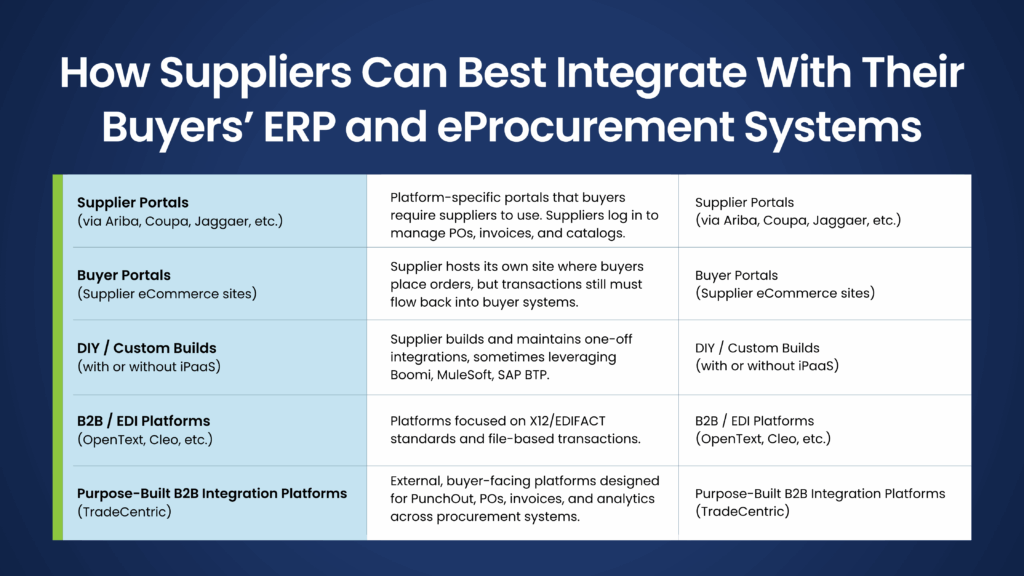
Quick Comparison
| Option | Description | Who It’s Best For |
| Supplier Portals (via Ariba, Coupa, Jaggaer, etc.) | Platform-specific portals that buyers require suppliers to use. Suppliers log in to manage POs, invoices, and catalogs. | Small suppliers needing immediate compliance with minimal IT investment |
| Buyer Portals (Supplier eCommerce sites) | Supplier hosts its own site where buyers place orders, but transactions still must flow back into buyer systems. | Niche use cases where brand control is critical and buyers tolerate extra effort |
| DIY / Custom Builds (with or without iPaaS) | Supplier builds and maintains one-off integrations, sometimes leveraging Boomi, MuleSoft, SAP BTP. | Suppliers with deep IT resources serving only a few buyers |
| B2B / EDI Platforms (OpenText, Cleo, etc.) | Platforms focused on X12/EDIFACT standards and file-based transactions. | Suppliers with buyers that mandate legacy EDI compliance |
| Purpose-Built B2B Integration Platforms (TradeCentric) | External, buyer-facing platforms designed for PunchOut, POs, invoices, and analytics across procurement systems. | Suppliers needing scalable, automated, and modern buyer integrations |
Final Thoughts
Integrating with buyers’ ERP and procurement systems is a revenue strategy. Buyers will always favor suppliers who are easy to transact with.
- Buyers portals can provide a quick digital starting point, but they force buyers to leave their eProcurement systems and create extra work.
- DIY can get you started, but it’s rarely sustainable beyond a few connections.
- iPaaS keeps your internal systems connected and governed.
- B2B/EDI platforms cover legacy EDI and compliance needs.
- Purpose-built B2B integration Platforms like TradeCentric bridge the gap with modern procurement systems, ensuring you can deliver punchout, PO, and invoice flows reliably.
For most enterprise suppliers, the winning formula is TradeCentric + iPaaS + (if needed) EDI. Together, they cover the full spectrum of buyer requirements and protect your team from the cost of building every connection by hand.