

Parts 1 and 2 established why agentic commerce won’t simply replace PunchOut, the demand isn’t there, the supplier reluctance is real, and the operational requirements at enterprise scale are far more complex than most vendor narratives acknowledge. So where does that leave us?
The answer isn’t that PunchOut stays frozen. It’s that PunchOut can evolve in one specific and meaningful way: by enabling a conversational interface to drive the cart-to-PO experience, rather than requiring a visit to the supplier’s PunchOut-enabled eCommerce site. This is what we mean by agentic PunchOut: not a wholesale replacement of the procurement infrastructure, but a conversational interface layered on top of it. The agent may operate with varying degrees of autonomy, from AI-assisted to semi-autonomous, depending on buyer and supplier preferences. What remains constant is the governed infrastructure underneath.
That’s a bounded, achievable evolution, and it preserves everything enterprises already depend on.
The Core Shift: Conversation Replaces the Site Visit
Today’s PunchOut flow is straightforward: the buyer launches from their procurement system into the supplier’s site, builds a cart, and returns to the procurement system with a PO ready for approval. The site visit is the human-interactive step.
In a conversational model, that site visit is replaced by a dialogue, but the underlying data flow, governance, and compliance requirements remain unchanged. The same governed integration middleware that manages authentication, entitlements, business rules, and cart transfer today continues to do so. The conversation is a new front door. The infrastructure behind it stays the same.
This matters because it means the conversational evolution of PunchOut isn’t a rebuild. It’s an extension.
The Critical Question: Who Owns the Conversation?
The conversational model can be implemented in two ways, and the difference between them is significant, not technically, but commercially.
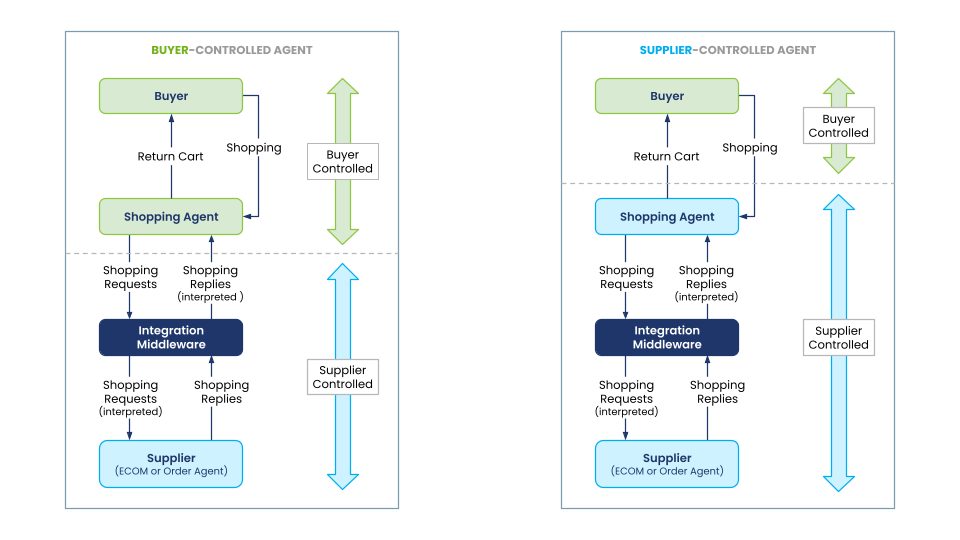
In a supplier-controlled model, the supplier hosts and controls the conversational agent. The buyer launches from their procurement platform into the supplier’s conversational interface, builds a cart through dialogue, and transfers it back as a validated PO. From the buyer’s perspective, the navigational path mirrors traditional PunchOut, the same two clicks to launch into the supplier’s interface and return the cart. But the experience in between is fundamentally different: instead of browsing a site UI, the buyer is shopping and building their cart conversationally. Same flow, transformed experience. From the supplier’s perspective, everything that matters stays in their control: the product data, the pricing, the entitlements, and the customer experience. The integration middleware still governs the handoff, and can optionally facilitate the conversation-to-API translation between the agent and the supplier’s systems.
In a buyer-controlled model, the buyer’s procurement platform hosts the conversational agent. The buyer never leaves their own environment, they describe what they need, the agent queries the supplier, builds the cart, and the PO is ready without a site visit. From the buyer’s perspective, this model could offer a marginally more seamless experience, no launch-and-return clicks required. But that advantage is only realized if the agent UX is well-implemented. A poorly designed buyer-controlled agent could easily introduce more friction than traditional PunchOut, not less. But from the supplier’s perspective, this model creates two serious problems: their product data flows into a system they don’t control, making real-time price comparison across suppliers trivially easy; and their customer experience is fully commoditized, indistinguishable from every other supplier in the buyer’s catalog.
The table below captures the essential tradeoff:
| SUPPLIER-CONTROLLED | BUYER-CONTROLLED | |
| Product data control | Supplier | Buyer |
| Pricing exposure | Protected | Vulnerable to comparison |
| CX & brand control | Supplier | Fully commoditized |
| Buyer experience | Same navigational path as traditional PunchOut; transformed shopping experience | Potentially seamless, but only if implemented well; poorly designed agent UX could easily add more friction than the traditional model |
| Supplier willingness | High | Low |
The table above captures the commercial implications of each model. The diagrams below show what the buyer’s journey actually looks like in each case.
Why Suppliers Will Drive the Decision
The conclusion from Part 2 was that suppliers won’t expose their catalogs to uncontrolled agents. That same logic applies here and it points clearly toward the supplier-controlled model.
Suppliers have invested in their eCommerce experiences because that’s where they control the relationship. A conversational agent they own and operate is a natural extension of that investment. It serves the buyer in a familiar, high-quality way while keeping the supplier’s data, pricing, and brand experience where they want it: in their own hands.
A buyer-controlled agent, by contrast, asks suppliers to hand over the very things they’ve been protecting. Not only would most suppliers refuse, but those who’ve already integrated PunchOut have even less reason to cede that control, their existing experience is already working.
The supplier-controlled conversational model isn’t just the more commercially viable path. For buyers and suppliers already connected through PunchOut, it’s also the lowest-friction upgrade. The integration infrastructure is already in place. The trust relationship is established. The conversational layer is an enhancement, not a replacement.
Viability Isn’t the Same as Adoption
It’s worth being clear-eyed about one thing: just because this evolution is technically viable and commercially logical doesn’t mean adoption will be swift or broad.
For suppliers who already have a well-functioning PunchOut-enabled eCommerce site, the switching cost is real. Their buyers are trained. The integration works. The CX is established. Adding a conversational layer requires investment in the agent, in the conversation-to-API translation, in testing across buyer relationships, without an obvious forcing function from the buyer side. For this segment, the agentic PunchOut is a compelling upgrade, but probably not an urgent one.
The more interesting opportunity is elsewhere: the large and underserved segment of manufacturers and suppliers who have never meaningfully invested in digital channels at all. For them, an agentic PunchOut experience isn’t an upgrade. It’s an on-ramp, a way to participate in governed, enterprise-grade B2B commerce without first building a full eCommerce site.
That’s a different value proposition entirely, and it’s what Part 4 is about.
Get the Agentic Commerce Readiness Framework for B2B Suppliers
Download the 7-part framework to assess your own agentic commerce readiness