


Table of Contents
The order to cash (O2C) process, also known as the O2C cycle, is the backbone of every B2B supplier’s financial operation. It encompasses every step from when a buyer places an order to when payment is received and reconciled. In today’s B2B ecosystem, suppliers manage this process across multiple platforms (eCommerce storefronts, ERP systems, and buyer eProcurement environments) making accuracy, speed, and integration essential.
That’s where TradeCentric comes in. As the leading integration platform built to connect and automate these systems, TradeCentric simplifies the entire O2C journey for faster cash flow, fewer errors, and a more connected buyer experience.
What Is the Order to Cash (O2C) Process?
The order to cash process covers all operational and financial activities required to fulfill a customer order and recognize revenue.
Optimizing O2C enables suppliers to accelerate revenue recognition, improve reporting accuracy, and strengthen customer relationships through transparency and responsiveness.
Steps in the Order to Cash Business Process
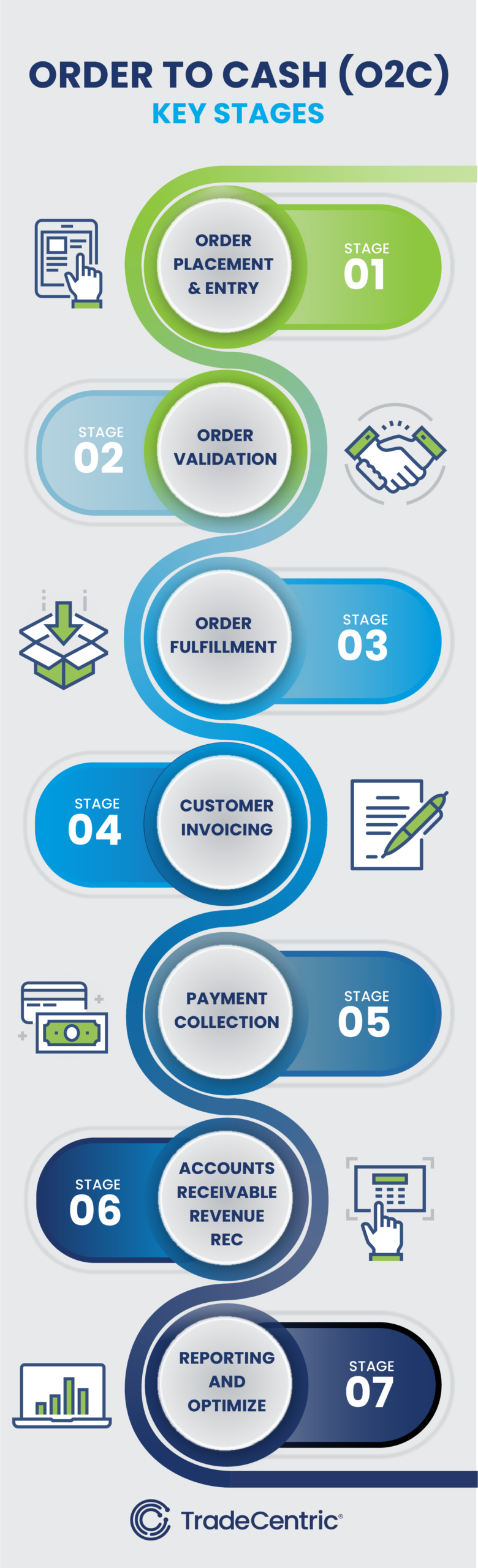
- Order Placement and Entry: A buyer places an order through several possible channels, including a buyer portal through an eCommerce site, eProcurement system via PunchOut, or an ERP system. Accurate data capture at this stage prevents downstream errors.
- Order Validation: The supplier’s eCommerce platform validates pricing, unit of measure, and product availability.
- Order Fulfillment: Products are picked, packed, and shipped—supported by real-time data synchronization between systems.
- Customer Invoicing: The supplier generates and transmits invoices tied to the buyer’s original PO.
- Payment Collection: Payments are received and reconciled
- Accounts Receivable and Revenue Recognition: Finance ensures payment is properly logged and revenue is recorded accurately.
- Reporting and Optimization: Analyze order cycle time, accuracy, and Days Sales Outstanding (DSO).
Why the Order to Cash Process Matters
The order to cash process is where revenue becomes reality. It connects every part of the buyer-supplier relationship, from purchase to payment, and determines how efficiently a business operates and how satisfied its customers feel.
When managed well, O2C doesn’t just keep orders moving; it drives profitability, loyalty, and long-term growth.
- Cash Flow Acceleration: Automated validation and invoicing shorten payment cycles and reduce DSO.
- Customer Retention: Accurate, transparent transactions build trust and repeat business.
- Operational Efficiency: Automation eliminates manual data entry and rework.
- Compliance and Audit Readiness: Consistent digital documentation ensures traceability and financial integrity.
Common Challenges in Managing the O2C Cycle
Despite its importance, many suppliers face friction within O2C workflows for several reasons:
- Disconnected systems between eCommerce, ERP, and eProcurement platforms
- Manual data entry leading to invoicing errors
- Limited visibility into order and payment status
- Delayed cash flow due to approval bottlenecks
- Inconsistent compliance tracking across systems
TradeCentric eliminates these barriers by integrating buyer and supplier systems—automating order, invoice, and payment workflows for a truly connected O2C cycle.
How TradeCentric Automates the Order to Cash Process
Connect Buyer and Supplier Systems
TradeCentric integrates supplier eCommerce platforms with buyer eProcurement and ERP systems to enable seamless order exchange, validation, and acknowledgments.
Automate Purchase Order and Invoice Flow
POs and invoices are automatically transmitted and reconciled, aligning on pricing and quantities to reduce disputes.
Sync Data Across ERP, WMS, and Finance Systems
Validated orders flow directly into ERPs for fulfillment, while payment and invoice data synchronize back into finance systems.
Increase Accuracy and Speed
Automation eliminates manual errors, accelerates approvals, and ensures consistent data across all systems.
Enhance Buyer Experience
Buyers enjoy instant acknowledgments, accurate invoices, and real-time visibility all within their own procurement environments.
Ready to automate your O2C process?
Order to Cash vs. Procure to Pay
In every B2B transaction, there are two sides of the same coin: Procure-to-Pay (P2P) on the buyer side and O2C on the supplier side. While P2P focuses on how buyers request, approve, and pay for goods, O2C governs how suppliers receive, fulfill, and recognize revenue from those orders.
These processes are deeply interconnected, meaning when one breaks down, both parties feel the impact. A smooth O2C process not only ensures that suppliers get paid faster, but also supports buyers’ need for efficiency, accuracy, and compliance across the purchasing journey.
| Process | Focus | Starts With | Ends With | Primary Users |
|---|---|---|---|---|
| Order to Cash (O2C) | Sales and revenue | Customer order | Payment receipt | Suppliers |
| Procure to Pay (P2P) | Purchasing and spend management | Purchase request | Supplier payment | Buyers |
How TradeCentric Connects Both
TradeCentric bridges P2P and O2C, enabling real-time data flow between buyers and suppliers for a fully connected commerce ecosystem.
Benefits of Order to Cash Automation
Automating the O2C process transforms how suppliers manage revenue, relationships, and operations. By digitizing document exchange and reducing manual intervention, organizations gain speed, accuracy, and visibility across the full transaction lifecycle.
- 30% faster payment collection through real-time invoice transmission
- Fewer manual errors and billing exceptions
- Improved forecasting with unified data visibility
- Greater scalability for enterprise supplier networks
- Higher buyer satisfaction through transparency and reliability
Best Practices to Optimize Your O2C Cycle
Optimization doesn’t happen by chance, it requires strategy, alignment, and the right technology foundation. Suppliers that integrate and automate their systems not only reduce friction but also gain better control over performance and outcomes.
- Integrate eCommerce, ERP, and procurement systems to remove manual touchpoints.
- Automate key documents: orders, invoices, acknowledgments, and ASNs.
- Track DSO and fulfillment metrics to measure performance.
- Enable real-time visibility for finance and operations teams.
- Regularly audit workflows for compliance and continuous improvement.
Industries That Benefit from O2C Automation
O2C automation delivers measurable value across industries where accuracy, compliance, and transaction speed are critical.
- Manufacturing: Streamline complex order fulfillment and invoicing cycles.
- Healthcare and Life Sciences: Maintain compliance and traceability.
- Education: Simplify institutional purchasing and reconciliation.
- IT and Industrial Suppliers: Manage high transaction volumes efficiently.
Transform Your O2C Process with TradeCentric
TradeCentric helps B2B suppliers automate the entire order to cash cycle—from PO to payment, improving accuracy, compliance, and buyer satisfaction.
See how TradeCentric transforms your O2C process
Frequently asked questions
Order to cash (O2C) is the process that covers every step from when a buyer places an order to when payment is received and recorded.
The O2C process steps include order placement, fulfillment, invoicing, payment collection, accounts receivable, and reporting.
TradeCentric automates the O2C process by connecting eCommerce, ERP, and eProcurement systems to synchronize orders, invoices, and payments automatically.
The difference between order to cash and procure to pay is that O2C focuses on the supplier’s side—getting paid for fulfilled orders—while P2P covers the buyer’s purchasing and payment processes.