


Table of Contents
The business landscape is rapidly evolving, with companies seeking ways to streamline operations, increase efficiency, and enhance overall productivity. One significant transformation in the finance and procurement world is the adoption of automated invoice processing, otherwise known as invoice automation.
Manual invoice processing drains resources, wastes time, and invites costly errors. Finance teams are expected to process more invoices with fewer resources, while vendors demand faster, more reliable payments. Businesses that rely on outdated, paper-based workflows risk delayed payments, strained supplier relationships, and limited visibility into their financial operations.
So, what are the top invoice automation processing benefits? Let’s explore.
What is Automated Invoice Processing?
Automated invoice processing is the use of technology to handle supplier invoices without manual data entry. Instead of an Accounts Payable team member manually keying in invoice details, matching purchase orders, and routing paperwork for approval, the system does all of that automatically. At its core, automated invoice processing software eliminates the manual entry of invoice data by automatically translating and delivering it into a buyer’s eProcurement system.
How Automated Invoice Processing Works
Understanding how automated invoice processing works helps clarify why it delivers such significant efficiency gains. The typical workflow follows these stages:
- Invoice Capture: Invoices arrive in various formats like email attachments, supplier portals, EDI, or scanned paper documents. AI-powered OCR extracts key details like invoice numbers, vendor information, and line-item charges automatically.
- Data Extraction and Validation: The system cross-references extracted data against purchase orders, contracts, and historical records. Discrepancies such as duplicate invoices, incorrect totals, or missing approvals are flagged instantly for review.
- Approval Workflow: Invoices are automatically routed to the right approvers based on predefined rules. Approvers receive instant notifications and can review from any device, eliminating email chains and manual follow-ups.
- ERP Integration: Once approved, invoice data syncs seamlessly with your ERP or accounting system, eliminating duplicate data entry and maintaining consistent financial records.
- Payment Processing: Payments are scheduled automatically based on due dates, vendor agreements, and cash flow priorities, processed via ACH, wire transfer, or virtual card.
- Monitoring and Audit Readiness: Every step is logged digitally, creating a complete audit trail that simplifies compliance reporting and spend analysis.
Imagine a scenario where, after a transaction is completed or an order is shipped, a supplier’s system instantly generates an invoice. This technology then fetches the invoice data from external systems such as eCommerce platforms, ERPs, or other order management solutions and translates it into a format tailored to the buyer’s specifications.
Once this transformation is done, the invoice is directly and seamlessly sent to the buyer’s eProcurement or ERP system, awaiting approval and subsequent routing for payment.
The result? A streamlined, efficient, and hassle-free invoicing process.
Accounts Payable and Receivable
The buyer’s Accounts Payable (AP) team manages money owed to suppliers, while the supplier’s Accounts Receivable (AR) team manages money owed by customers. In other words, AP sits on the buyer side of the transaction, AR on the supplier side. Aligning invoice automation with both sides eliminates blind spots and accelerates the full procure-to-pay and order-to-cash cycles.
Need an Invoice Automation Solution?
Automated Invoice Processing Benefits
Manual invoicing drains resources, wastes time, and invites error for both Accounts Payable (buyer) and Accounts Receivable (supplier) teams. These inefficiencies ripple across the procure-to-pay and order-to-cash cycles, delaying reconciliation and obscuring spend visibility.
1. Streamlined Workflows (Buyer)
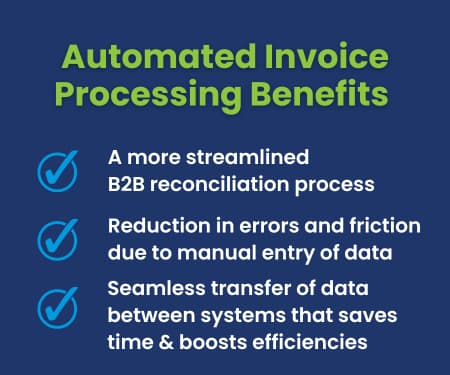
Traditional manual processes associated with invoicing are not only tedious but also prone to errors. Automation ensures that workflows are smooth and streamlined, translating to faster processing times and fewer hiccups along the way. Automated approval routing eliminates the need for manual hand-offs, meaning invoices that once took days to process can be approved in hours or less.
2. Cost Savings (Buyer)
Reducing manual processing and data entry means fewer errors and, subsequently, lower human capital costs. When AP teams minimize manual entries, they not only save time but also the costs associated with rectifying manual input errors. Beyond labor savings, automated invoice processing helps businesses capture early payment discounts and avoid late fees, compounding ROI over time as invoice volumes grow.
3. Timely Invoice Payments (Buyer)
A smooth and efficient invoice processing system ensures payments are made on time, every time. This strengthens the business relationship between buyers and suppliers by establishing trust and credibility. With automated reminders and payment scheduling, businesses can prioritize payments strategically based on due dates and cash flow, without relying on manual tracking.
4. Prevention of Errors and Delays (Supplier)
With automated invoicing, manual errors become a hurdle of the past. By automating the flow of invoice data directly to customers, there’s a significant reduction in mistakes that can cause delays in payments. This ensures that AR teams receive their dues promptly. Automated validation catches discrepancies before they reach the buyer’s AP team, reducing invoice rejections and the back-and-forth that slows down payment cycles.
5. Quicker Payment Cycles (Supplier)
When invoices are sent electronically in formats tailored for a buyer’s system, they get processed faster, leading to quicker payments. Automated invoices seamlessly flow into customers’ systems for internal routing and approval, thereby decreasing the outstanding Accounts Receivable (AR) durations. Shorter AR cycles improve cash flow predictability and give suppliers greater confidence in forecasting revenue.
6. Expand Business Opportunities (Supplier)
Offering Invoice Automation can be a unique selling point for suppliers. It not only strengthens relationships with existing customers but can also be an attractive proposition for potential large customers. By offering such advanced solutions, suppliers can grow their revenue base and establish themselves as modern, tech-savvy businesses. Enterprise buyers increasingly require electronic invoicing capabilities from their suppliers, making invoice automation a prerequisite for winning and retaining large accounts.
7. Enhanced Three-Way Matching (Buyer & Supplier)
The technology ensures superior 3-way matching between Purchase Orders (POs), invoices, and order receipts. When integrated with a PO Automation solution, this matching becomes even more accurate, drastically reducing the chances of discrepancies and ensuring a smoother reconciliation process for accounts payable teams.
8. Maximize Visibility (Buyer & Supplier)
Navigating through heaps of paperwork and traditional filing methods obstructs a clear, overall insight into entire operational processes. This absence of transparency might result in overlooked problems such as inefficiencies, unreported expenses, and incomplete financial records, among other challenges. Invoice automation elevates operational visibility, ensuring every stage of the process is transparent and manageable, allowing for real-time problem-solving and enhancement of overall workflow efficiency. Built-in tolerance thresholds allow minor variances to pass through automatically, while flagging genuine discrepancies for human review, striking the right balance between control and efficiency.
Manual vs. Automated Invoice Processing
| Capability | Manual | Automated |
|---|---|---|
| Data Entry | Manual keying, error-prone | AI-powered OCR capture |
| Approval Workflow | Email and paper routing | Rules-based auto-routing |
| Processing Time | Days or weeks | Hours or less |
| Error Handling | Caught late, requires rework | Flagged instantly |
| Visibility | Limited, lagging | Real-time tracking |
| Compliance | Manual tracking, audit risk | Digital audit trails |
| Tax Compliance | Manual 1099/W-9 tracking | Automated preparation |
Key Features of TradeCentric’s Invoice Automation Solution
Automated Data Translation & PO-Level Validation
TradeCentric converts supplier invoices into buyer-specific formats including cXML, EDI, JSON and more, then validates each against the original PO. Buyers (AP) gain touchless three-way match, faster approvals, and clearer spend visibility. Suppliers (AR) see fewer invoice rejections and quicker payment.
Real-Time System-to-System Integration
Integration can link 75+ eCommerce platforms with 220+ ERP or eProcurement systems for instantaneous invoice exchange. Buyers receive ready-to-pay invoices directly inside its ERP, unlocking early-payment discounts and real-time spend control. Sellers eliminate duplicate portals, freeing staff for strategic account and revenue initiatives.
TradeCentric Analytics Portal
TradeCentric Analytics tracks delivery status, failures, and cycle times across every invoice route in real time. AP teams spot bottlenecks early, resolve holds, and close books faster. AR forecasts cash flow confidently and demonstrates performance to buyers with shareable dashboards.
Redefining Invoice Automation with TradeCentric
In a world where businesses are striving for a competitive edge, invoice automation stands out as a powerful tool in streamlining processes and enhancing efficiency.
It’s more than just a technological upgrade—it’s a strategic move towards optimized operations and stronger supplier relationships. Whether you’re a large enterprise or a growing startup, embracing an invoice automation solution can be a game-changer for your business.
Thousands of companies around the world rely on TradeCentric’s connected commerce solutions, including invoice processing automation, to achieve integrated and automated B2B trade. Contact us to get started.
Frequently asked questions
Automated invoice processing uses software powered by AI, ML, and OCR to capture, validate, approve, and reconcile invoices automatically, replacing manual data entry and paper-based workflows.
When an invoice doesn’t match the PO, invoice automation software applies built-in tolerance thresholds. If the discrepancy exceeds the acceptable tolerance, the system flags it as an exception for the AP team to resolve before payment is issued.
Yes. Leading invoice automation solutions include enterprise-grade security features such as data encryption, role-based access controls, fraud detection, and full audit trails to protect sensitive financial data.
Suppliers benefit from faster payment cycles, fewer invoice rejections, and reduced administrative burden. Automated invoices flow directly into buyer systems for approval, shortening AR durations and improving cash flow predictability.